
Comprehensive Economic Development Strategy
Overview
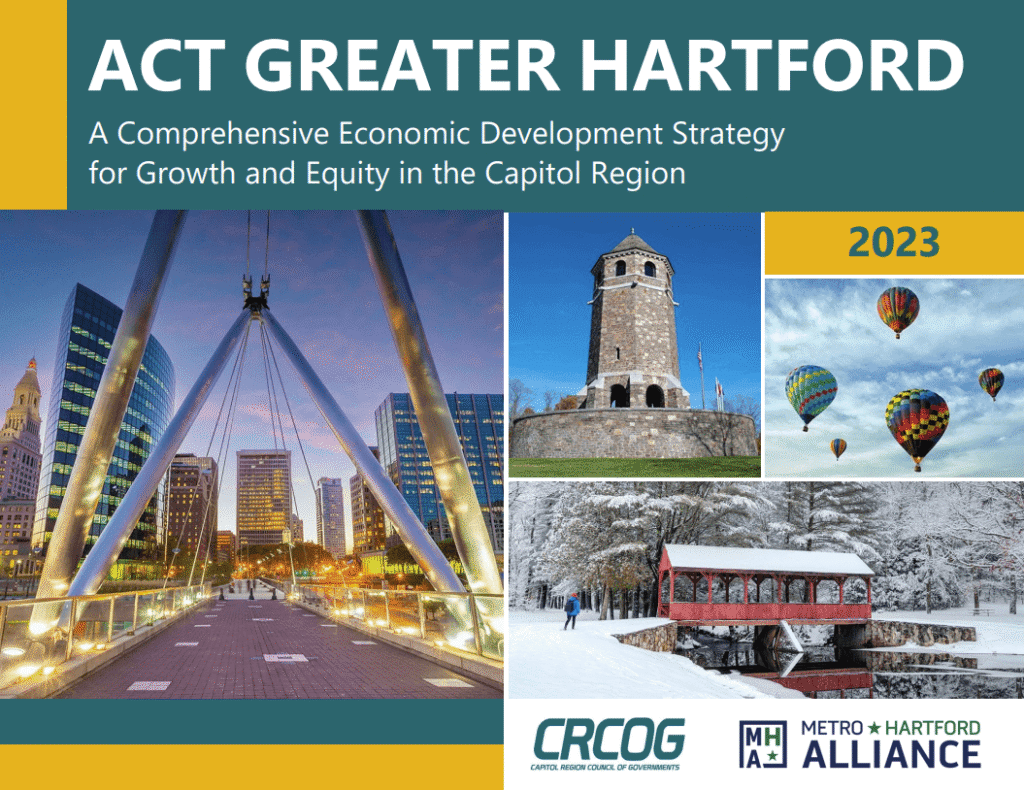
CRCOG’s Comprehensive Economic Development Strategy (CEDS) is designed to accelerate inclusive economic growth by raising incomes across the income spectrum with particular attention given to opportunities for engaging those who have often been left behind. The strategy is intended to be actionable, specific, and focused with an emphasis on building upon the region’s assets that hold the greatest promise for long-term change.
The updated CEDS for 2023-2028 picks up on the inclusive themes of the prior city, regional, and statewide economic and workforce planning initiatives, noting that while some progress has been made, new challenges and more focus are needed in five areas. The five priority areas of focus are:
- Adapt the physical environment to meet the current and future needs of businesses and residents.
- Break down barriers to encourage entrepreneurs and small businesses to take root and grow.
- Give hyperfocus on existing businesses which includes addressing immediate workforce needs, nurturing young adults, attracting talent, supporting high-growth business owners, and implementing highly structured business expansion and retention programs.
- Provide intense, continued attention to economic inclusion, especially regarding neighborhood-based development and in fixing the “broken rung” of increasing workforce participation rates and providing workplace advancement opportunities for women and underrepresented employees.
- Restructure the organizational framework for success which centers on a highly-engaged Implementation Committee and hiring a highly talented manager to coordinate the implementation of the CEDS and serve as a catalyst for change by brokering collaborative relationships and driving the nuts and bolts of the Greater Hartford economic agenda.
Read the Plan Here
Introduction to the Plan
A five-year Comprehensive Economic Development Strategy (CEDS) for the Hartford, Connecticut region was prepared. Titled Metro Hartford Future, Accelerating Shared, and Sustained Economic Growth, it portrayed the budding optimism of a community that would build its future on a foundation of inclusive economic growth.
Access the full plan as a pdf here.
Dive into the Plan
The Plan Break Down
Each goal has been broken down into their own sections to quickly and easily access the action items in the plan.
Open each tab below to review the initiatives and actions under each of the plan’s goals.
Adapt the physical environment to meet the current & future needs of businesses & residents
Purpose: Maintain and invest in infrastructure and the built environment to support the economy and well-being of all residents. The attraction and retention of talent and business are in large measure tied to the quality of the place. Amenities that improve the quality of life in a community matter. This includes recreational, cultural, and natural attributes of a community as well as the built physical spaces that provide diverse housing options throughout the region for all ages and incomes, a variety of goods and services, workplaces that are inviting and inspire creativity and a sense of belonging, and multi-modal transportation systems and services that give people access to places they want and need to be.
In the meantime, the Capitol Region and its competitors must give diligent thought and aggressive action to reimagining the built environment to keep the best of what it has while positioning itself as an attractive location for new generations of talent.
Focus on adaptive reuse of buildings in urban & suburban core areas
- Develop more collaborative workspaces
- Create downtown neighborhood districts
- Provide spaces that create a strong network for spurring creative talent
- Target young professionals and empty nesters by facilitating mixed-use developments
- Create fund for small scale developers
Reshape the regional housing market
- Develop a 360-degree regional future housing strategy
- Create a program geared toward first-time homebuyers
- Support mixed-income housing development throughout the region
Advance regional connectivity
- Support Hartford400 Vision
- Support Greater Hartford Mobility Study (GHMS)

Break down barriers for entrepreneurs & small businesses
Purpose: Creating opportunities for ANYONE with a good idea to start a business will unlock the region’s innovation potential, creating a more resilient, diverse, and equitable economy that is grounded locally and grows from within. Entrepreneurship plays a crucial role in fostering innovation by creating new products, services, and business models; creating jobs; and stimulating economic growth. Entrepreneurship also plays an important role in community development by creating jobs for local underemployed and unemployed individuals, facilitating local investment, empowering members of the community to take charge of their own future, and creating businesses that address environmental or social challenges.
National research shows that entrepreneurship can narrow the racial wealth gap: annual rates of return on business investment for entrepreneurs are around 20% for Black households, 17% for Hispanic households, and 15% for white households.
Take the pulse of the entrepreneurial ecosystem
- Conduct a regional ecosystem assessment
- Convene an advisory group of underrepresented entrepreneurs and business owners
Grow youth entrepreneurship opportunities
- Build a pipeline of young talent
- Weave entrepreneurship through education and workforce development
- Highlight entrepreneurship as a
viable career option - Create experiential opportunities in entrepreneurship
Create a front door to the regional entrepreneurial ecosystem
- Create a digital resource navigator
- Hire an in-person resource navigator
Expand access to capital for entrepreneurs and small businesses
- Review loan application processes
- Deepen relationships with the region’s local CDFIs
- Attract and grow minority-owned and operating lending institutions and fintech companies

Hyperfocus on existing businesses
Purpose: Support sustainability, resiliency, and emerging opportunities of advanced Manufacturing, Insurance/Finance, and Technology as well as Business Support sectors in the Capitol Region. Across the region’s economy, businesses of all sizes and from all sectors are desperate for workers, a problem that is only going to get worse as more Baby Boomers near retirement in the coming years.
In the meantime, the Capitol Region and its competitors must give diligent thought and aggressive action to reimagining the built environment to keep the best of what it has while positioning itself as an attractive location for new generations of talent.
Significantly expand business retention & expansion (BRE) efforts
- Design a collaborative BRE program
Prioritize investment into training & retaining the future workforce
- Expand Dual Track programs
- Expand K-12 career exploration
- Continue to advance career navigation efforts
- Collaborate around data
Support industry-led workforce development efforts
- Continue to prioritize regional sector partnerships
- Elevate discussions around emerging trends to create a future-ready workforce
Establish consistent messaging that is regionally shared
- Form an image and identity partnership
- Develop an open-source regionally generated brand identity
- Implement a new collaborative regional branding and image campaign
Launch a ‘smart’ data-driven talent attraction campaign
- Identify top gap occupations to attract and create unique profiles for each
- Conduct a geographic competitive analysis
- Launch a marketing strategy
Focus business attraction on emerging opportunities
- Pursue midsized, high growth business opportunities
- Encourage corporations in the Capitol Region to assess their out-of-state real estate portfolios

Create equitable economic opportunity
Purpose: Ensuring a sustainable, resilient, and growing economy will require creating opportunities for all residents to gain access to, participate in, and contribute to the regional economy as consumers, workers, and founders.
One of the pillars of economic and community development is to promote economic security and quality of life for all citizens of a community. Creating an equitable economic environment that offers opportunities for underserved and marginalized citizens unlocks the full strength of a regional economy. When compared to other communities in Connecticut and across the nation, the Capitol Region scores average or slightly higher in certain prosperity score categories, including school poverty, air pollution, and commute time. However, the region lags in median wage, unemployment, poverty, education, and rent burden. Implementing plans and strategies to address the equity environment in the Capitol Region is important to creating a thriving economy that ensures all citizens have access to employment opportunities and support services that help move the entire region forward.
Embrace diversity, equity, and inclusion regionally (DEI)
- Adopt DEI economic development agenda
- Develop a regional equity and diversity dashboard
- Support the formation of other business organizations representing undersupported business owners
Grow youth entrepreneurship opportunities
- Build a pipeline of young talent
- Weave entrepreneurship through education and workforce development
- Highlight entrepreneurship as a
viable career option - Create experiential opportunities in entrepreneurship
Take a collaborative, neighborhood-scale approach to development
- Layer resources into neighborhoods disconnected from prosperity – concentrated poverty
- Develop housing that is affordable and accessible downtown and in suburban communities
- Increase access to childcare and health/mental care
- Increase quality of K-12 education in areas of concentrated poverty
Fix the broken rung to advance women & underrepresented employees into more senior roles
- Conduct a 360-degree career pathways analysis and strategy for the region’s economy
- Create, connect and amplify management and career advancement training programs for women and underrepresented employees
- Expand events and programming for women and underrepresented managers to build and grow their professional networks
- Increase accommodations for working parents

Restructure the CEDS implementation framework
Purpose: It is imperative that strong focus be given to management and accountability measures to implement the CEDS. In recent years, implementation of CEDS goals was shared among different stakeholder groups without benefit of a centralized, day-to-day point of contact to effectively manage multiple priorities. Achieving the desired outcomes of the updated CEDS requires full-time focus to address systemic challenges, change patterns of behaviors, and secure strong support and commitment from civic champions.
Restructure the CEDS
- Restructure the CEDS implementation committee
- Procure multi-year funding to hire an experienced executive