Regional Climate Action Plan (CPRG)
Climate Pollution Reduction Grant (CPRG) Overview
CRCOG is developing a regional climate action plan, supported by the EPA’s Climate Pollution Reduction Grants (CPRG), a five-billion-dollar program created under the Inflation Reduction Act to help state and regional governments reduce greenhouse gases. The first phase involves noncompetitive planning grants at both the state level, and then to the 67 most populous Metropolitan Statistical Areas (MSAs). In the case of Connecticut, three MSAs received one-million-dollar planning grants: Hartford-East Hartford-Middletown (led by CRCOG), Bridgeport-Stamford-Norwalk (led by MetroCOG), and New Haven-Milford (led by SCRCOG).
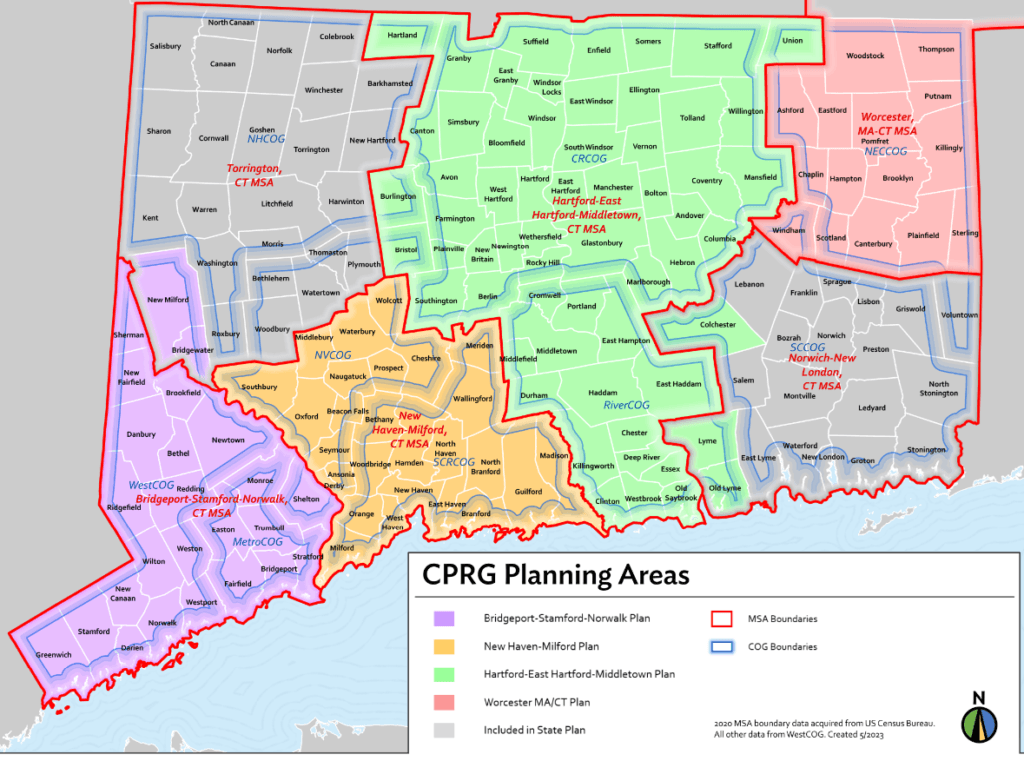
Figure 1: Municipalities in green will be included in the Hartford-East Hartford-Middletown MSA’s Regional Climate Action Plan.
Final CCAP
Read the Comprehensive Climate Action Plan (CCAP) here:
Project Background
The Comprehensive Climate Action Plan (CCAP) is the second part of the CPRG Planning Phase that builds off the stakeholder engagement and analysis completed in the Priority Climate Action Plan. The CCAP focuses on quantifying greenhouse gas (GHG) emissions by sector and outlines reduction targets set by the State of Connecticut. The Plan identifies GHG reduction measures to reach these targets, discusses anticipated benefits and disbenefits for each measure, reviews authority to implement, provides workforce planning analysis, and maps available funding.
CCAP PRIORITY MEASURES
The following greenhouse gas (GHG) reduction measures are featured in our CCAP by sector:
Agricultural/Natural & Working Lands
- Urban Tree Canopy: This measure aims to increase tree canopy coverage across the region to match the City of Hartford’s goal of 35 percent coverage.
Electricity Generation
- Support the Increase of Solar Projects in the Region, Creating 900 Megawatts Across the Region: This measure seeks to expand solar generation across the region through supporting a variety of strategies.
Commercial/Residential Buildings
- Reduce Municipal, Residential, and Commercial Reliance on Heating Oil by 5 percent: This measure focuses on decreasing by 5 percent the region’s reliance on heating oil by switching to electric heat pumps, natural gas, or propane.
Transportation
- Install Public Electric Vehicle (EV) Charging Stations: This measure seeks to incentivize individuals to switch to EVs by providing a framework for municipalities to collaborate in public EV charging infrastructure installation.
- Pursue 1-2 percent Mode Shift Away from Single Occupancy Vehicles (SOV): This measure seeks to achieve a 1-2 percent mode shift away from SOV using a variety of strategies from increased transit This measure seeks to achieve a 1-2 percent mode shift away from SOV using a variety of strategies from increased transit usage availability, to reinvesting in the built environment to facilitate an increase in walking and biking.
- Switch Lawn and Garden Equipment to Electric: This measure seeks to promote the switch to electric equipment by working with municipalities across the region to promote the use of electric equipment.
- Convert light-duty municipal fleets to electric vehicles (EV)/hybrids. Encourage municipality-owned and privately-owned school buses to switch to electric fleets or renewable diesel (R-99), propane, and/or compressed natural gas (CNG) as interim measures: This measure encourages municipalities to convert their light duty fleets to EV/hybrids and encourage municipality-owned and privately-owned school buses to go electric. As an interim measure, these buses could be switched to renewable diesel (R-99), propane, and/or compressed natural gas (CNG).
Waste and Materials Management
- Reduce the Region’s Waste by Establishing and Expanding Residential and Academic Food Waste/ Food Rescue Diversion Programs and Increase Utilization of Anaerobic Digestion: This measure aims to divert 23 percent of the region’s food and organics waste by 2030 through expanding and supporting current food diversion efforts underway, while developing new programs and services across the region.
Final PCAP
Read the Priority Climate Action Plan (PCAP) here:
Project Background
The CPRG program consists of two primary phases – planning and implementation. The major deliverables for the planning phase are a Priority Climate Action Plan (PCAP) and a more detailed Comprehensive Climate Action Plan (CCAP). Approximately $4.6 billion in competitive funding will be available during CPRG’s implementation phase. All eligible implementation projects must be identified within the corresponding regional or statewide PCAP measures.
PCAP PRIORITY MEASURES
The following greenhouse gas (GHG) reduction measures are featured in our PCAP by sector:
Agricultural/Natural & Working Lands
Urban Tree Canopy: Increase urban tree canopy in municipalities across the region
Commercial/Residential Buildings
- Energy Audits and Implementation Support for Commercial and Residential Buildings: Expand the region’s commercial and residential energy audit programs and provide support for implementation
- Energy Efficiency Upgrades to Municipal Buildings: Undertake energy efficiency upgrades to municipal buildings
Electricity Generation
- Solar on Affordable Housing: Install renewable energy (solar and battery) on residences owned by municipal housing authorities and municipality-owned affordable housing
- Solar, Battery Storage, and/or Microgrids for Municipal Buildings, Properties, and Schools: Install solar panels, add battery storage and develop microgrids on buildings and properties owned by municipalities (e.g. schools, town halls, parking lots)
Transportation
- Municipal Electric Vehicle (EV) Fleet Conversion: Convert light duty municipal fleets to electric vehicles (EV)/hybrids, install municipal changing infrastructure, and switch municipal gas-powered equipment, such as leaf blowers, to electric
- Public EV Chargers: Install public EV charging infrastructure and fund maintenance of EV charging infrastructure
- Biodiesel/EV School Buses: Encourage municipality-owned and privately-owned school buses switch to 20 percent biodiesel (B20) as an interim measure with a long-term focus on converting light duty municipal fleets to electric vehicles (EV)/hybrids
- Transit Priority Corridor Improvements: Pursue recommended improvements for at least one of the six transit corridors highlighted in Metro Hartford Rapid Routes Transit Priority Corridors Study
- Roundabout Projects: Develop and implement roundabout projects across the region, with a focus on LIDACs
- Complete Streets Projects: Encourage mode shift across the region with complete streets projects that make it safer and easier to bike and walk for all users
Waste and Materials Management
- Residential and Academic Food Waste Diversion: Establish and expand residential and academic food waste diversion programs and examine ways to increase utilization of anaerobic digestion
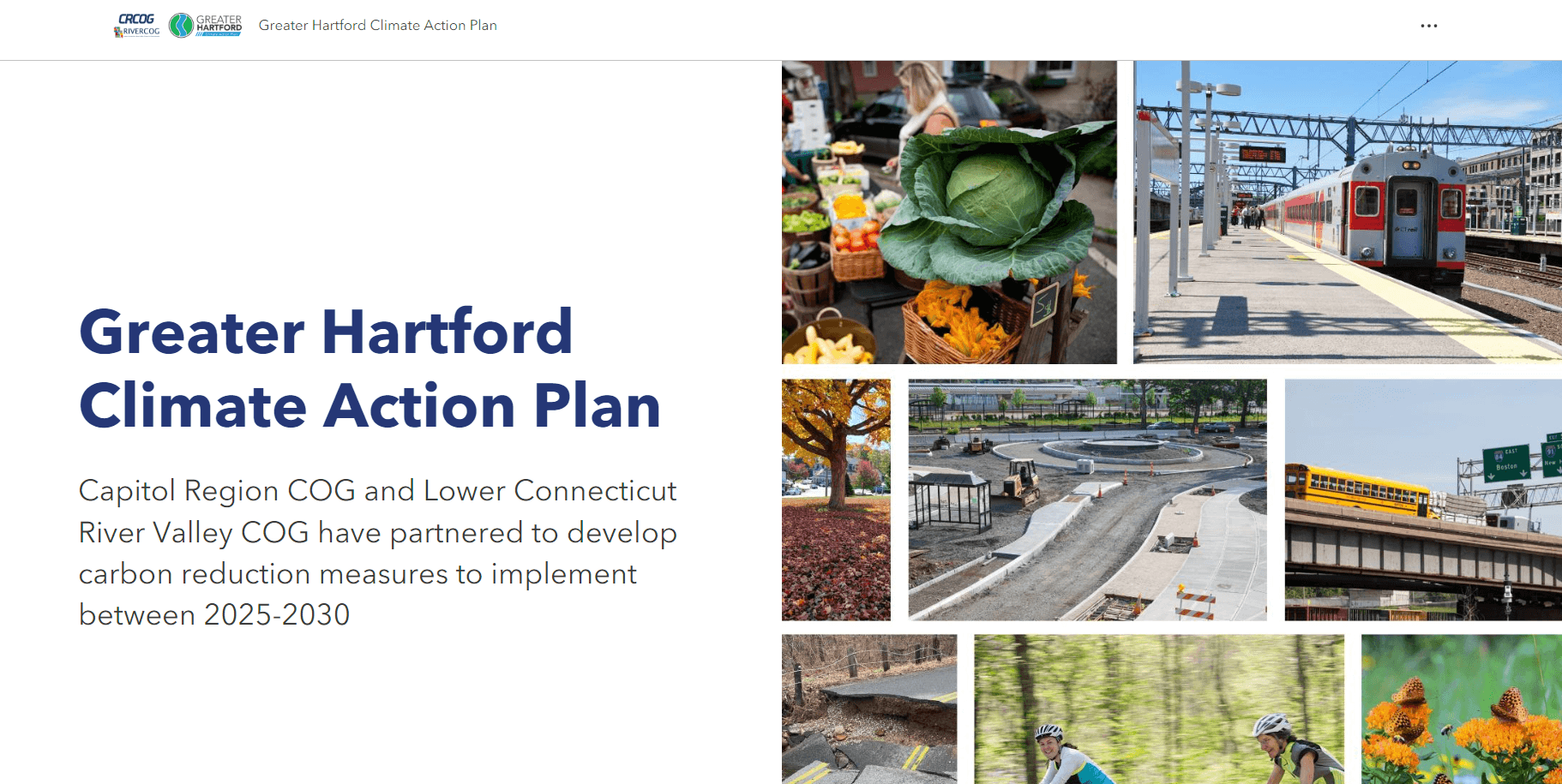
PCAP PRIORITY MEASURES
CCAP Public Comment Meeting July 30, 2025
PCAP Public Comment Meeting #2 February 8, 2024
PCAP Public Comment Meeting #1 February 1, 2024
Connecticut Conference of Municipalities (CCM) Kick-Off Webinar November 14, 2023
Frequently Asked Questions (FAQs)
What is the Climate Pollution Reduction Grant and where can I learn more about it?
The Climate Pollution Reduction Grant, or CPRG, was created under the Inflation Reduction Act and is being administered through the U.S. Environmental Protection Agency. You can learn more about the grant in general by visiting EPA.gov.
The grant is for $1,000,000 across four years. It is specifically earmarked for planning to reduce greenhouse gas emissions across the Hartford-East Hartford-Middletown Metropolitan Statistical Area (MSA). An additional $4.6 billion is available for competitive implementation grants for projects identified in Priority Climate Action Plans (PCAPs).
What communities are in your plan?
There are 60 communities in the Hartford region’s CPRG planning area, including primarily CRCOG and RiverCOG member communities. Municipalities in our plan include: Andover, Avon, Berlin, Bloomfield, Bolton, Bristol, Burlington, Canton, Chester, Clinton, Colchester, Columbia, Coventry, Cromwell, Durham, Deep River, East Granby, East Haddam, East Hampton, East Hartford, East Windsor, Ellington, Enfield, Essex, Farmington, Glastonbury, Granby, Haddam, Hartford, Hartland, Hebron, Killingworth, Lyme, Manchester, Mansfield, Marlborough, Middlefield, Middletown, New Britain, Newington, Old Lyme, Old Saybrook, Plainville, Portland, Rocky Hill, Simsbury, Somers, South Windsor, Southington, Stafford, Suffield, Tolland, Union, Vernon, West Hartford, Westbrook, Wethersfield, Willington, Windsor, and Windsor Locks.
Who are CRCOG and RiverCOG, and what do you do?
Connecticut does not have county governments – instead we have 9 COGs, or Councils of Government. We are regional planning agencies that support the municipalities in our regions on issues like transportation, land use, economic development, environmental protection, and more. You can learn more about CRCOG at crcogct.org and RiverCOG at rivercog.org
What are the next steps for this project?
CRCOG highly encourages proactive engagement from municipalities to ensure their priority projects are identified in the PCAP. For more information, please contact Kyle Shiel, Principal Planner and CPRG project manager at kshiel@crcogct.org.
What is the timeline?
The grant spans four years, starting June of 2023. We submitted our Priority Climate Action Plan (PCAP) before March 1st, 2024. Implementation grant applications are due April 1st, 2024. The Comprehensive Climate Action Plan (CCAP) is due in 2025. We will submit Program Status Reports between 2025 and 2027.
What sort of activities would be eligible for the implementation funding? / What isn’t eligible under the grant?
Eligible implementation projects are determined by the priority measures listed in our region’s PCAP. Some eligible projects based on our PCAP reduction measures may include:
- Expanding non-motorized transportation options, like multiuse trails or bicycle lanes.
- Building electric vehicle infrastructure.
- Promoting or subsidizing renewable energy projects, like solar panels on the roofs of municipal buildings.
- Implementing waste reduction strategies, like diverting organics away from landfills and burn plants and into composting operations.
- Providing energy audits and implementation support, to ensure residential and commercial buildings use less fossil fuel powered energy.
These are just a few possible examples. Projects or programs able to demonstrate a quantified reduction in greenhouse gas emissions are likely potential projects.
Proposals such as increasing carbon sinks through protecting open space or climate adaptation (like building infrastructure to withstand extreme weather) would fall outside the scope of this grant.
What’s the distinction between adaptation and mitigation?
Adaption generally refers to projects that help us respond to climate change, like flood barriers or cooling centers. Mitigation generally means making the impacts of climate change less severe by preventing or reducing the emission of greenhouse gases (GHG) into the atmosphere. Both adaptation and mitigation are important. If we address adaptation without mitigation, it’s a bit like scooping water out of a sinking ship before patching up the leaks.
The first step to reducing our emissions is understanding where they come from. That’s why we are working to develop a greenhouse gas inventory specific to our region. The next step is where you come in: we need community input to take the most meaningful, effective actions possible.
What kind of input do you need?
We appreciate everyone who took time to participate in our PCAP Public Engagement and Outreach efforts or provide feedback on our PCAP Draft. Please stay tuned for information about additional opportunities to provide input on our Regional Climate Action Plan.
What if I don’t live in the greater Hartford region?
These Climate Pollution Reduction Grants span the majority of the U.S. There are two other regions with their own grants – Bridgeport and New Haven, while the CT Department of Energy & Environmental Protection is creating a plan to cover the rest of the state. Any community in Connecticut will be covered by one of these plans.
How can I stay involved/learn more/keep updated?
Check this site for updates and follow CRCOG various social media channels. You may also contact the CPRG project manager Kyle Shiel at kshiel at crcog dot org.
Local Government Strategy Series
This resource provides an overview of greenhouse gas (GHG) emissions reduction strategies local governments can use to achieve economic, environmental, social, and human health benefits. Specific strategies include: energy efficiency, transportation, community planning and design, solid waste and materials management, and renewable energy.